
The Parts of a Pool Cue
Knowing the anatomy of a pool cue gives you a real advantage at the table. There are two main parts of a pool cue, the shaft and the butt. These combine to form a fully assembled cue, but each is made up of several components that affect how the cue plays, feels, and holds up over time. This guide covers every part of a pool cue so you know exactly what you are working with.
In this guide
Pool Cue Shaft
The pool cue shaft is the slimmer top portion of the stick, typically made from maple wood or carbon fiber. Arguably the shaft is the most vital piece of equipment because of its influence on every shot a player takes. In addition to the tip connecting with the cue ball, the player uses the pool cue shaft to maintain stability by resting it on their bridge hand.
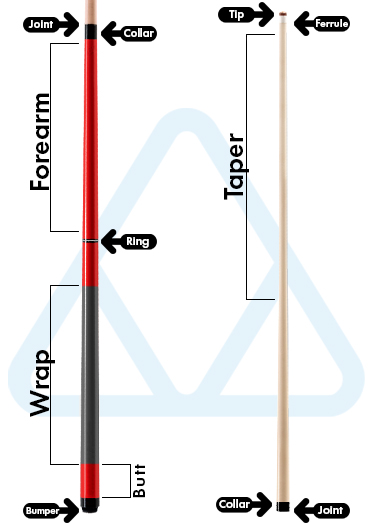
The shaft can be further broken down into the following parts:
The pool cue tip strikes the ball, making it incredibly important to your game. Pool cue tips can be soft or hard depending on your personal preference, and average tip sizes range from 11mm up to 14mm.
The ferrule is the part that sits directly below the tip, usually white in color. It acts as the backbone of the cue tip, reducing vibration when striking the ball and protecting the shaft from the impact of each shot.
The collar strengthens the connecting pin of the joint to ensure that the power from the butt appropriately transfers to the shaft when you take a shot.
Sitting at the bottom of the shaft is the joint, which connects it to the butt. The joint may be made of metal, wood, or another material, and it may have a joint protector attached to protect it from damage when the cue is disassembled.
Pool Cue Butt
The butt is the thicker bottom part of the assembled pool cue. While some may consider it the less important of the two main parts, the butt is where your shot power comes from. You grip it with your dominant hand and use the proper amount of force to strike the cue ball.
The other parts that make up the butt include:
Positioned at the top of the butt is the pin, usually made of metal, which connects directly to the pool cue shaft at the joint. The pin is what holds the two halves of the cue together.
The collar on the butt, typically positioned under the pin, serves the same function as the one on the shaft, transferring energy cleanly between the two halves of the cue on every shot.
Aside from adding length to the stick, the forearm is primarily aesthetic. Many cues feature decorative designs on the forearm to suit the player's preference, from simple stain finishes to elaborate inlay work.
Inlays and rings are decorative elements set into the forearm or butt sleeve, available in a wide variety of materials that often differ from the rest of the cue. Exotic inlays made of precious metals, shell, or high-end wood can significantly increase the price of the stick.
The wrap has both a style component and a functional purpose, giving the player a better grip on the stick and absorbing moisture during play. Wraps are typically made of leather or linen, though rubber sport wraps and no-wrap options are also common.
The butt sleeve sits below the wrap and provides overall balance to the stick. It is usually made from the same material as the forearm and shares the same finish or design.
Typically made of rubber, the bumper sits at the very bottom of the butt to prevent scuffs and other damage when the cue is set down or transported.
Why Understanding Pool Cue Anatomy Can Up Your Game
All parts of a pool cue come together and impact every shot you take. The specific weight of each component affects the overall balance, and that weight distribution affects how you stabilize your hands to generate the correct power on every shot. The anatomy of a pool cue is not complex, but being aware of these parts is crucial to your game and to knowing when something needs to be repaired or replaced.
Frequently Asked Questions About Pool Cue Parts
Here are answers to some of the most common questions we get about pool cue anatomy and components.
Get Your Next Pool Cue at FCI Billiards
Whether you are looking for a full pool cue, a shaft, or billiard accessories, FCI Billiards carries brands you can trust with an unmatched selection. From the beginner to the seasoned professional, there is a perfect pool cue for everyone at FCI Billiards.
Find the Right Cue at FCI Billiards
We carry pool cues, shafts, tips, and accessories from every major brand. Free shipping on orders over $50.
Shop All Pool CuesRelated Articles
 How to Choose the Best Pool Cue Tips to Improve Your Game How to Choose the Best Pool Cue Tips to Improve Your Game
Choosing the best pool cue tips for your playing style is one of the most important choices you can make to improve your game. |
 How to Choose a Pool Cue: 9 Things to Keep in Mind How to Choose a Pool Cue: 9 Things to Keep in Mind
With so many brands, materials, and styles available, buying a pool cue can feel overwhelming. Here is how to narrow it down. |
 How to Get Better at Pool How to Get Better at Pool
Practice drills, positioning fundamentals, and shot-making tips to elevate your game. |
Recent Posts
-
Best Pool Cue Cases
Updated: May 20, 2026 The right cue case is the most important piece of equipment you own after …Feb 22nd 2026 -
Best Pool Cues for Intermediate Players: 9 Perfect Picks
When your game outgrows your equipment, it's time to upgrade. Knowing you've hit that point is easy …Jan 22nd 2025 -
How to Replace a Pool Cue Tip in 5 Easy Steps
Originally published December 6th, 2024 — Updated June 10, 2026 A pool cue tip may not be the mos …Dec 6th 2024