
How to Hold a Pool Stick (the Right Way)

The proper grip is the foundation of every shot. Learning how to hold a pool stick correctly is one of the first — and most overlooked — fundamentals in the game. This guide covers grip pressure, bridge technique, cue material, and common mistakes to avoid.
In this guide
Why Proper Pool Grip Technique Matters
Many new players focus on stance and aim while completely neglecting how they hold the cue. That's a mistake. Your grip is the only physical connection between you and the shot — small inconsistencies compound into big misses.
Accuracy
A stable, repeatable grip lets you align the cue to your target line and hold that line through the stroke. When your grip shifts between shots — even slightly — your aim resets from scratch every time.
Speed and Spin Control
The pressure you apply, and where your fingers sit on the cue, directly affects how much force transfers into the cue ball and at what angle. Good grip technique gives you deliberate control over power and english (side spin) rather than accidental variation.
Comfort and Reduced Fatigue
Gripping too tightly tenses the entire arm, shortens your stroke, and causes hand fatigue within a few racks. A relaxed grip lets you play longer sessions without losing consistency.
Muscle Memory and Consistency
Pool is a game of repetition. Holding the cue the same way on every shot builds muscle memory — so your body can reproduce a good stroke automatically rather than consciously working through each step.
How Cue Construction Material Affects Your Grip
The material your cue is made from — particularly the wrap on the butt — has a direct effect on how it feels in your hand and how much control you can exert.
Leather and Linen Wraps
The most popular wrap materials. Leather offers a slightly textured, natural feel that molds to your hand over time. Linen wraps have a tighter weave that provides good tackiness without feeling sticky. Both are durable and comfortable for long sessions.
Rubber Wraps
Tackier than leather or linen, rubber wraps are ideal for players with sweaty hands or those who prefer maximum grip security. The tradeoff is less feedback — rubber absorbs some of the vibration that tells you how cleanly you struck the cue ball.
Unwrapped Wood
Some experienced players prefer a bare maple or ash butt with no wrap. Wood provides the most direct feedback from each shot. The downside is that smooth wood can become slippery with moisture. Players who prefer unwrapped cues often apply a thin layer of rosin powder to improve grip.
Carbon Fiber
Carbon fiber cues are increasingly popular for their stiffness, consistency, and moisture resistance. An unwrapped carbon fiber butt feels similar to bare wood but maintains a more uniform surface year-round — it won't swell or warp in humid conditions the way wood can.
How to Hold a Pool Cue Properly: Step-by-Step
The following technique is the standard starting point taught by instructors and used by most recreational and competitive players. Learn this foundation first — if you develop a personal variation that produces better results, use it.
Right-handed players grip the cue with their right hand; left-handed players with their left. Place your hand near the center of the wrap area on the butt, with your palm roughly facing down.
Use your thumb, index finger, and middle finger. Your thumb rests underneath the cue; your index and middle fingers wrap over the top. Your ring and pinky fingers can rest lightly on the cue — they're there for comfort, not control.
This is the step most players get wrong. Your grip should be firm enough that the cue won't slip, but loose enough that you could slide the cue forward and back with minimal effort. A helpful mental image: hold the cue like a small bird — tight enough it can't escape, gentle enough you won't hurt it. If your knuckles are white, loosen up.
Your bridge hand — the one resting on the table — guides the cue shaft and keeps it level. Plant it firmly on the table behind the cue ball. See the next section for how to form an open or closed bridge.
Keep the cue as parallel to the table surface as possible as you stroke. Raising the back end imparts unintended topspin and throws off your aim. The only time you deliberately elevate the cue is for a massé shot — an advanced technique.
Don't stop your stroke the moment the cue contacts the ball. Continue the forward motion several inches past the original ball position. A complete follow-through ensures consistent power transfer and prevents the "punch" stroke that kills accuracy.

Open Bridge vs. Closed Bridge
Your bridge hand is just as important as your grip hand. The two standard techniques each have distinct advantages — most players learn both and choose based on the shot.
| Open Bridge | Closed Bridge |
|---|---|
| Best for beginners Press your hand flat on the table and lift your thumb against your index finger to create a V-shaped groove. The cue shaft rests in this groove and slides through it as you stroke. The open bridge gives you a clear view of the cue tip and cue ball. |
More control Form a loop with your thumb and index finger around the cue shaft, letting the shaft rest on your middle finger inside the loop. The closed bridge restricts lateral movement, giving the cue a more stable track. Preferred by most experienced players for standard shots. |
There's no rule saying you must use one or the other. Many players use an open bridge for short, simple shots and switch to a closed bridge for longer shots that require more precision. Experiment with both.
Common Pool Grip Mistakes to Avoid
Gripping Too Tightly
A tense grip restricts your pendulum swing and causes the cue to veer off line. It also fatigues your hand quickly. If your shots are pulling left or right without explanation, check your grip pressure first.
Gripping in the Wrong Place
Your grip hand should sit near the center of the wrap area so that your elbow forms roughly a 90-degree angle when the cue tip is near the cue ball. Gripping too far back shortens your stroke; gripping too far forward reduces leverage and power.
Moving the Bridge Hand Mid-Stroke
Your bridge hand should be completely still from the moment you take final aim until well after follow-through. Any movement — even a subtle lift — will redirect the cue shaft and send the cue ball off course.
Rushing the Stroke
Most grip-related miscues happen because the player rushes. Take your practice strokes, pause briefly at the back of your final stroke, then deliver the cue smoothly. Speed at impact matters; speed of the overall stroke motion does not.
Ignoring Bridge Length
The distance between your bridge hand and the cue ball affects control. A bridge that's too short cramps your stroke; too long and the shaft flexes and wobbles. Aim for 6–8 inches for most shots, shortening when tight against a cushion.
Frequently Asked Questions
Ready to Find the Right Cue for Your Grip?
FCI Billiards carries 500+ pool cues from every major brand — from beginner hard rock maple cues to professional carbon fiber shafts. Free shipping on orders over $50.
Shop All Pool CuesRelated Articles
 The Parts of a Pool Cue The Parts of a Pool Cue
Pool cue anatomy explained — shaft, butt, ferrule, tip, and joint — and why each part affects your game. |
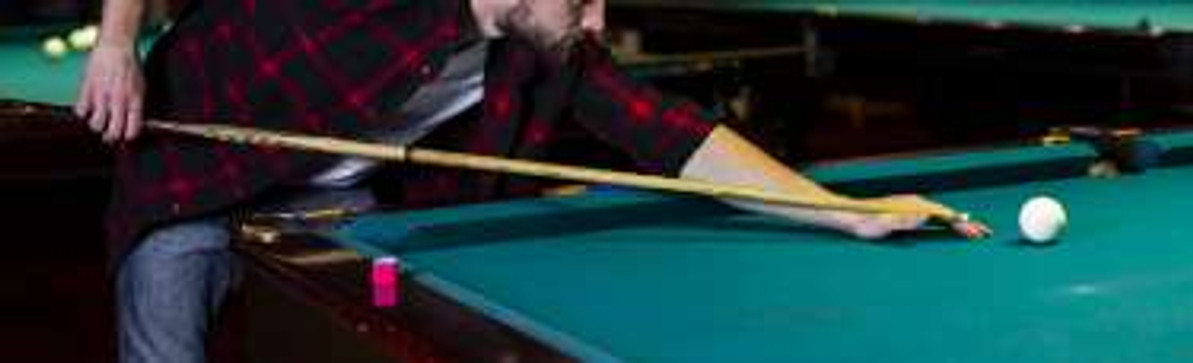 How to Choose a Pool Cue: 9 Things to Keep in Mind How to Choose a Pool Cue: 9 Things to Keep in Mind
Weight, tip diameter, shaft material, wrap type — everything you need to know before buying. |
 How to Get Better at Pool How to Get Better at Pool
Practice drills, positioning fundamentals, and shot-making tips to elevate your game. |
Recent Posts
-
Best Pool Cue Cases
Updated: May 20, 2026 The right cue case is the most important piece of equipment you own after …Feb 22nd 2026 -
Best Pool Cues for Intermediate Players: 9 Perfect Picks from FCI Billiards
January 22, 2025 By FCI Billiards When your game has progressed beyond the basics, it may be ti …Jan 22nd 2025 -
How to Replace a Pool Cue Tip in 5 Easy Steps
December 6, 2024 By FCI Billiards A pool cue tip may not be the most exciting piece of equipmen …Dec 6th 2024